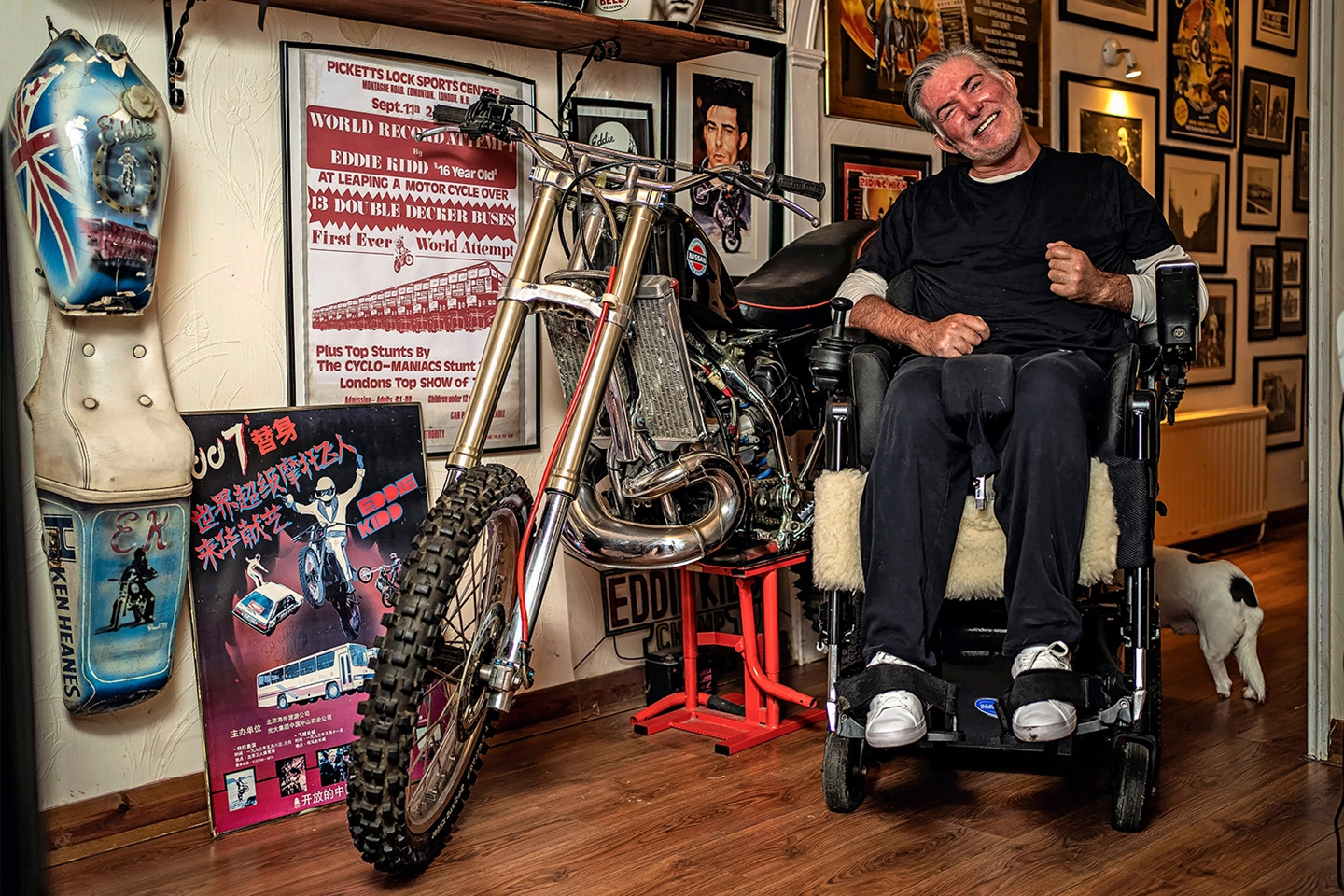
Eddie Kidd: The Daredevil’s Daredevil
In the pantheon of British legends, few stories are as simultaneously triumphant and heartbreaking as that of Eddie Kidd. Long before the era of CGI superheroes, he was a real-life action hero, a man who defied gravity and death for a living, captivating millions with his breathtaking motorcycle jumps. His name became synonymous with raw courage and show-stopping spectacle. From humble beginnings in North London to global fame, his journey is one of unparalleled success, a devastating accident that changed everything, and a subsequent life defined by resilience. This is the comprehensive story of a man who flew higher than any other, faced an unimaginable challenge, and whose spirit continues to inspire long after the roar of the crowds faded. The legacy of Eddie Kidd is a powerful testament to the human spirit’s capacity for both daring and endurance.
Early Life and the Lure of the Motorcycle
The story of the stuntman Eddie Kidd begins not on a Hollywood set, but in the streets of Islington, London. Born in 1959, his childhood was far from glamorous, marked by time in a children’s home and a natural rebellious streak that often got him into trouble. It was this very restlessness, however, that found a perfect outlet when he discovered motorbikes at the age of twelve. The machine wasn’t just a vehicle; it was an escape and a calling. He taught himself to ride with a fearlessness that was immediately apparent, quickly progressing from simple riding to performing small, daring stunts for his friends, displaying a preternatural talent for controlling a motorcycle in mid-air.
His raw skill and complete lack of fear did not go unnoticed for long. By his mid-teens, he was already being noticed by local promoters and the burgeoning stunt scene. He left school with a single, burning ambition: to become a professional stuntman. His first major break came in 1974 when, at just fifteen years old, he successfully jumped over thirteen double-decker buses. This wasn’t just a local novelty act; it was a statement of intent that was broadcast to the nation. The sight of a teenager flying through the air on a motorcycle captured the public’s imagination, instantly making Eddie Kidd a name to watch and setting the stage for a career that would define an era of daredevil entertainment.
The Rise to Stardom and Record-Breaking Jumps
As the 1970s progressed, so did the scale and ambition of Kidd’s jumps. He understood that to stay in the public eye, he had to constantly push the boundaries of what was considered possible. Each new stunt was designed to be bigger, longer, and more dangerous than the last. He began systematically breaking world records, including a stunning jump over 22 cars and a leap across the 90-foot gap at the Quarter Mile Bridge in Essex. These feats were not just about the distance; they were theatrical events, building immense tension before the heart-stopping moment of acceleration and flight, followed by the collective roar of relief and admiration from the crowd.
His fame skyrocketed, transforming him from a skilled stunt performer into a genuine celebrity. He was no longer just a daredevil; he was a charismatic showman with movie-star looks, appearing on television talk shows and in magazines. The public adored his cheeky-chappy persona and his apparent invincibility. This period cemented his reputation as Britain’s answer to the American superstar Evel Knievel, but with a style and charm that was uniquely his own. The name Eddie Kidd became a brand, representing the ultimate in live-action entertainment and death-defying courage, making him a household name across the United Kingdom and beyond.
Rivalry with Evel Knievel and Global Acclaim
The natural comparison for any motorcycle stuntman in the 1970s was the flamboyant American, Evel Knievel. While Kidd always maintained a respectful attitude towards the pioneer, the media and promoters crafted a compelling narrative of a transatlantic rivalry. In many ways, Eddie Kidd was seen as the new, improved version—younger, more successful in his record attempts, and with a less brash, more approachable personality. This “rivalry” was never hostile, but it served to amplify Kidd’s fame, positioning him on a global stage and proving that the British daredevil could not only match but surpass his American counterpart.
Kidd’s international appeal was solidified through televised stunts and global publicity tours. He performed across Europe and was a major star in Japan, where his daring feats were met with immense enthusiasm. This global recognition was a testament to his universal appeal; the language of risk and triumph needed no translation. He was living proof that a kid from a London council estate could, through sheer talent and bravery, conquer the world. The Eddie Kidd phenomenon was now an export, a symbol of British grit and showmanship that resonated with audiences everywhere, making him one of the most recognizable sports entertainers of his generation.
Hollywood and the Silver Screen
With fame came the inevitable call from Hollywood. The film industry was eager to harness his authentic stuntman credentials and box-office appeal for a new wave of action movies. His most notable role came in the 1980 James Bond film, “For Your Eyes Only,” where he performed a breathtaking motorcycle stunt, jumping over a moving car in a corkscrew motion. This appearance introduced Eddie Kidd to a massive international audience and cemented his status as a top-tier stunt professional. He wasn’t just an actor playing a part; he was the real deal, performing his own stunts where others would use a double.
Beyond Bond, he appeared in other films and television shows, including “The Cannon and Ball Show” and the movie “The Word.” His on-screen presence was magnetic, blending his natural charisma with undeniable, real-world skill. These roles demonstrated a potential career pivot that could have seen him become a successful action movie star in his own right. The film work provided a new dimension to his career, proving that his talents extended beyond the live jump arena and into the realm of cinematic storytelling, further expanding the Eddie Kidd brand and solidifying his place in popular culture.
The Physics of a Motorcycle Jump
To truly appreciate the skill of Eddie Kidd, one must understand the immense physical and technical challenges of a motorcycle jump. It is a complex interplay of physics, engineering, and human nerve. The approach ramp, or takeoff ramp, must be calculated with precision; its angle determines the motorcycle’s trajectory. Too steep, and the bike will loop out backwards; too shallow, and it will nose-dive. The rider must hit the ramp at an exact speed—too slow results in falling short, too fast creates a dangerously high and flat arc, making the landing impact catastrophic. Kidd had an innate, almost subconscious understanding of these variables.
The moment of flight is one of vulnerability. The rider becomes a pilot, using subtle body English to keep the motorcycle level in the air, a technique known as “seat bouncing” or “clutching.” The landing is the most dangerous part, where the entire force of the impact is absorbed by the motorcycle’s suspension and the rider’s body. A miscalculation of a few miles per hour or a slight misalignment of the wheels upon landing could lead to a catastrophic crash. Eddie Kidd mastered this brutal physics equation through practice and an unparalleled feel for his machine, making the incredibly difficult look deceptively easy to the adoring crowds.
The Art of Showmanship
Beyond the raw courage and physical skill, Eddie Kidd was a master showman. He understood that a successful stunt was as much about theatre as it was about technique. The build-up was crucial: the slow ride along the crowd-lined approach, the revving of the engine, the focused wave to the audience. He cultivated a public image that was part rebel, part everyman, clad in his iconic white leathers adorned with sponsors. This persona made people connect with him; they weren’t just watching a stunt, they were willing their hero, Eddie Kidd, to succeed and survive.
His ability to work a crowd and generate media excitement was a key component of his success. He knew how to create a narrative around each jump, building a sense of impending drama that ensured massive attendance and television coverage. Whether it was a dedication to a cause or an attempt to break a specific record, he gave each event meaning. This showmanship elevated his stunts from mere spectacles to cultural events. People held their breath collectively, and they cheered collectively when he landed safely, a shared emotional experience orchestrated by the man on the motorcycle.
The Machinery and Safety Gear
The motorcycles Eddie Kidd rode were not standard showroom models; they were highly specialized machines built to withstand forces that would destroy a regular bike. He was most famously associated with Yamaha, particularly the Yamaha XT 500 and later, more powerful two-stroke machines. These bikes were heavily modified with strengthened frames, custom-tuned suspension with massive travel to absorb landing impacts, and knobbly tires for grip on the dirt ramps. The engines were tuned for raw, explosive power needed for the short, intense acceleration to jump speed, a far cry from the endurance tuning used for racing.
Despite the inherent danger of his profession, Kidd was a proponent of safety innovation within the context of the era. His iconic white leathers were not just for show; they were his primary protection in a crash. Made of thick, tough hide, they were designed to resist abrasion. Underneath, he would wear padding. His helmet was a state-of-the-art, full-face design, a critical piece of equipment that would ultimately save his life on more than one occasion. While safety standards in the 1970s and 80s were rudimentary compared to today, Eddie Kidd utilized the best available technology, understanding that his equipment was the only thing standing between him and disaster on a daily basis.
The Harsh Reality of a Stuntman’s Life
Behind the glamour and the adulation, the life of a professional stuntman like Eddie Kidd was one of constant pain and risk. The physical toll was immense; even successful jumps sent violent shocks through his body, leading to chronic back, knee, and neck injuries. Minor crashes were a regular occurrence, resulting in fractures, concussions, and severe bruising. This was a career lived on the very edge of physical endurance, where pain was a constant companion and the threat of a career-ending—or life-ending—injury loomed over every single performance. The price of fame was paid in aches and scars.
The Strategic Visionary: Unpacking the Career and Influence of Nigel Sharrocks
The psychological pressure was equally immense. Each jump required a supreme act of mental focus, suppressing the natural instinct of self-preservation. The weight of expectation from crowds, promoters, and sponsors created a burden that few could bear. After a jump, the adrenaline crash could be severe, leading to cycles of euphoria and depression. This high-stress lifestyle often spilled over into his personal life, affecting relationships and leading to periods of turmoil. The image of the unflappable hero belied the intense and often lonely reality faced by the man himself, a reality that was an integral, if hidden, part of the Eddie Kidd story.
The Devastating Accident at Heckington
The trajectory of Eddie Kidd‘s life and career was irrevocably altered on October 2, 1996. While performing a relatively simple stunt for a charity event at a horse show in Heckington, Lincolnshire, his motorcycle’s throttle stuck open. Unable to slow down, he collided with a wall at high speed. The impact was devastating. He suffered multiple skull fractures, a broken back, and severe brain injuries. He was placed in an induced coma and given only a slim chance of survival. The news sent shockwaves through the nation; the seemingly invincible hero had fallen in the most cruel and unexpected way.
The accident at Heckington was a tragic paradox. Having survived countless highly dangerous, record-breaking jumps, he was nearly killed at a low-key event. It underscored the ever-present danger of his profession, where even a routine performance could turn catastrophic in a split second due to a simple mechanical failure. The incident marked the brutal end of his stunt career and the beginning of a new, incredibly difficult chapter in his life. The world held its breath once more, but this time, it wasn’t for a thrilling jump; it was a collective prayer for the survival of a beloved icon.
The Long Road to Recovery
The initial prognosis was grim, but Eddie Kidd displayed a form of courage far greater than any jump: the will to rebuild a shattered life. He emerged from the coma after several weeks, but the severe brain injury had left him with significant physical and cognitive challenges. He had to relearn the most basic functions: how to speak, how to walk, and how to care for himself. His recovery was, and remains, a long and arduous process, requiring immense determination and years of intensive physiotherapy and rehabilitation. The man who once commanded a motorcycle with flawless precision now had to fight for every small movement.
This phase of his life revealed the strength of his character and the depth of the support around him, particularly from his family and his then-wife, Samantha. Their unwavering dedication became a cornerstone of his recovery. While the physical and cognitive effects of the injury are permanent, his progress has been remarkable. He learned to walk again with the aid of a frame, and his speech, though affected, returned. This new battle showcased a different kind of heroism, one defined not by fearless leaps but by daily perseverance, patience, and a refusal to be defeated by circumstance. The story of Eddie Kidd was no longer about defying gravity, but about defying the odds.
Legacy and Influence on Motorsports
The influence of Eddie Kidd on the world of motorsports and stunt riding is profound and enduring. He paved the way for a generation of British and European stunt riders, demonstrating that it was possible to achieve global fame from a base in the UK. His success showed that stunt riding could be a viable, mainstream form of entertainment, leading to more organized events, better safety standards, and increased media coverage for the sport. Modern stunt riders, whether they realize it or not, stand on the shoulders of the giant who broke down barriers and captured the public’s imagination in the 1970s and 80s.
His style of jump-focused stunts, combined with charismatic showmanship, became the blueprint for future daredevils. Furthermore, his foray into films helped bridge the gap between live stunt performance and cinematic action, raising the profile of professional stunt work in the movie industry. While technology and styles have evolved, the core elements he perfected—the dramatic build-up, the clean execution, and the triumphant landing—remain the foundation of the live stunt show. The legacy of Eddie Kidd is woven into the fabric of extreme sports, a testament to a pioneer who flew higher and farther than anyone before him.
A Life in the Public Eye
The relationship between Eddie Kidd and the British public is unique. He was not a distant celebrity but a folk hero, a figure people felt they knew and cared about deeply. His cheeky, working-class charm made him relatable, while his superhuman feats made him an object of awe. This connection ensured that his story remained in the public consciousness long after his accident. The nation celebrated his triumphs and, later, mourned his tragedy as if it had happened to a member of their own family. This enduring affection is a powerful indicator of the mark he left on the national psyche.
Even decades after his accident, his name evokes a strong sense of nostalgia and respect. Documentaries about his life are met with significant interest, and public appearances, though rare, are greeted with warmth and admiration. His life story serves as a powerful narrative arc of rise, fall, and resilience. The public’s ongoing support during his recovery, including fundraising efforts for his care, demonstrates a lasting bond. The Eddie Kidd narrative is more than a sports story; it is a human story that continues to resonate, reminding people of the fragility of life and the power of the human spirit.
The Man Behind the Legend
Away from the spotlights and the roaring engines, Eddie Kidd was a complex individual with a deep love for his family. He was a father, a husband, and a friend. Those close to him often spoke of his generous spirit and his loyalty. Like many who experience rapid fame from a young age, he also faced personal demons and challenges in navigating his identity beyond the stuntman persona. The pressure of maintaining his image and the physical toll of his career sometimes led to struggles that were hidden from his adoring fans, painting a picture of a man as human and vulnerable as anyone else.
His passion for motorcycles was not just professional; it was a fundamental part of who he was. Even after his accident, the sight and sound of a bike could bring a spark of recognition and joy to his eyes. Understanding this personal side is crucial to appreciating the full scope of his story. The legend of Eddie Kidd is built upon incredible public feats, but the man himself was a multifaceted individual whose life was shaped by the same desires, fears, and loves that touch us all, making his triumphs and his struggles all the more poignant and powerful.
Comparing the Eras: Kidd vs. Modern Stunt Culture
The world of stunt performance in which Eddie Kidd thrived was fundamentally different from today’s landscape. His era was defined by live, one-off spectacles where the margin for error was virtually zero. There were no second takes. The focus was on sheer distance and height, with jumps measured in the number of buses or cars cleared. Safety, while a concern, was rudimentary by modern standards, relying heavily on the rider’s skill and nerve. Promotion was achieved through television specials, newspaper coverage, and word-of-mouth, creating a sense of a major national event.
| Feature | The Eddie Kidd Era (1970s-1990s) | Modern Stunt Culture (2000s-Present) |
|---|---|---|
| Primary Medium | Live, one-off spectacles | Digital media, filmed segments, live tours |
| Focus | Record-breaking distance/height | Technical trickery, freestyle (FMX) |
| Safety Standards | Rudimentary (leathers, basic helmets) | Highly advanced (neck braces, airbag suits, precise landing ramps) |
| Promotion | TV specials, newspapers, magazines | YouTube, social media, global X-Games-style competitions |
| Business Model | Event gate receipts, sponsorships | Sponsorships, video revenue, appearance fees |
| Key Skills | Jump distance control, crowd showmanship | Aerial acrobatics, style, consistency for filming |
In contrast, modern stunt culture, particularly Freestyle Motocross (FMX), is heavily influenced by digital media and organized global competitions like the X-Games. The emphasis has shifted from pure distance to technical trickery—performing complex acrobatics like backflips and gravity-defying grabs while in the air. Safety has advanced dramatically with specialized equipment like neck braces and inflatable airbag landing systems. Today’s stars build their brands through social media and video parts, creating a more sustained, global presence rather than the event-based fame of Eddie Kidd. Both eras require immense bravery, but the nature of the risk and the path to success have evolved significantly.
A Lasting Symbol of Courage
The story of Eddie Kidd ultimately transcends the specifics of motorcycle stunts. He has become a lasting symbol of two distinct types of courage. The first is the bold, flamboyant courage of the daredevil—the willingness to stare down a terrifying physical challenge and conquer it through skill and nerve. This is the courage that made him famous. The second, and perhaps more profound, courage is the quiet, enduring kind he displayed after his accident: the courage to face a lifelong disability, to rebuild from nothing, and to find a new purpose in the face of overwhelming adversity.
His life serves as an powerful analogy for the human condition: the soaring highs of achievement and the devastating lows of tragedy. It’s a story that teaches us about the price of greatness and the resilience of the spirit. As his longtime friend and fellow racer James Whitham once reflected, “Eddie had no fear, he was the real deal. What people don’t see is the even greater bravery he’s shown since his accident. That’s the true measure of the man.” This duality is why his legacy endures. Eddie Kidd is remembered not only for the incredible jumps he made but for the incredible journey he has endured, inspiring people to face their own challenges with a fraction of his fortitude.
Conclusion
From the council estates of North London to the record-breaking jumps that captivated a nation, the life of Eddie Kidd is an epic tale of talent, fame, tragedy, and resilience. He was a true pioneer who defined an era of daredevil entertainment with his unique blend of unparalleled skill and charismatic showmanship. His name became a byword for courage and spectacle. The tragic accident that cut his career short could have been the final chapter, but instead, it revealed a deeper, more enduring strength within the man. His long and difficult recovery has been a masterclass in human perseverance, earning him a different, but no less significant, form of respect and admiration. The story of Eddie Kidd is a permanent fixture in British cultural history—a poignant and powerful reminder of the heights we can reach and the strength we can find when faced with life’s most difficult landings.
Frequently Asked Questions
What is Eddie Kidd most famous for?
Eddie Kidd is most famous for being a British motorcycle stuntman who set multiple world records in the 1970s and 1980s for jumping over increasingly large obstacles, including buses, cars, and even a river gap. His daring feats, charismatic personality, and movie-star looks made him a national icon and a household name during the peak of his career.
How did Eddie Kidd get into stunt riding?
His interest began in his early teens in London, where he found solace and an outlet for his rebellious energy on motorbikes. He taught himself to ride and perform stunts, quickly gaining a local reputation for his fearlessness. His natural talent was spotted by promoters, leading to his first major professional jump over thirteen double-decker buses at just fifteen years old, which launched his career.
What caused Eddie Kidd’s accident?
The accident occurred on October 2, 1996, during a charity stunt show in Heckington. The throttle on his motorcycle jammed wide open as he approached a ramp, preventing him from slowing down. He lost control and collided with a wall at high speed, suffering catastrophic injuries including severe brain trauma and a broken back, which ended his stunt career.
How is Eddie Kidd today?
Eddie Kidd survived his injuries but lives with the permanent effects of his traumatic brain injury. His recovery has been long and ongoing, requiring constant care and support from his family. While he has regained the ability to walk with assistance and speak, the accident left him with significant physical and cognitive challenges. He remains a beloved and respected figure, symbolizing incredible resilience.
What was Eddie Kidd’s connection to James Bond?
Eddie Kidd performed a spectacular motorcycle stunt for the 1981 James Bond film “For Your Eyes Only.” He executed a corkscrew jump over a moving car, showcasing his real-life stunt prowess on the big screen. This appearance brought him international fame and demonstrated the crossover appeal of his authentic daredevil skills into the world of cinema.