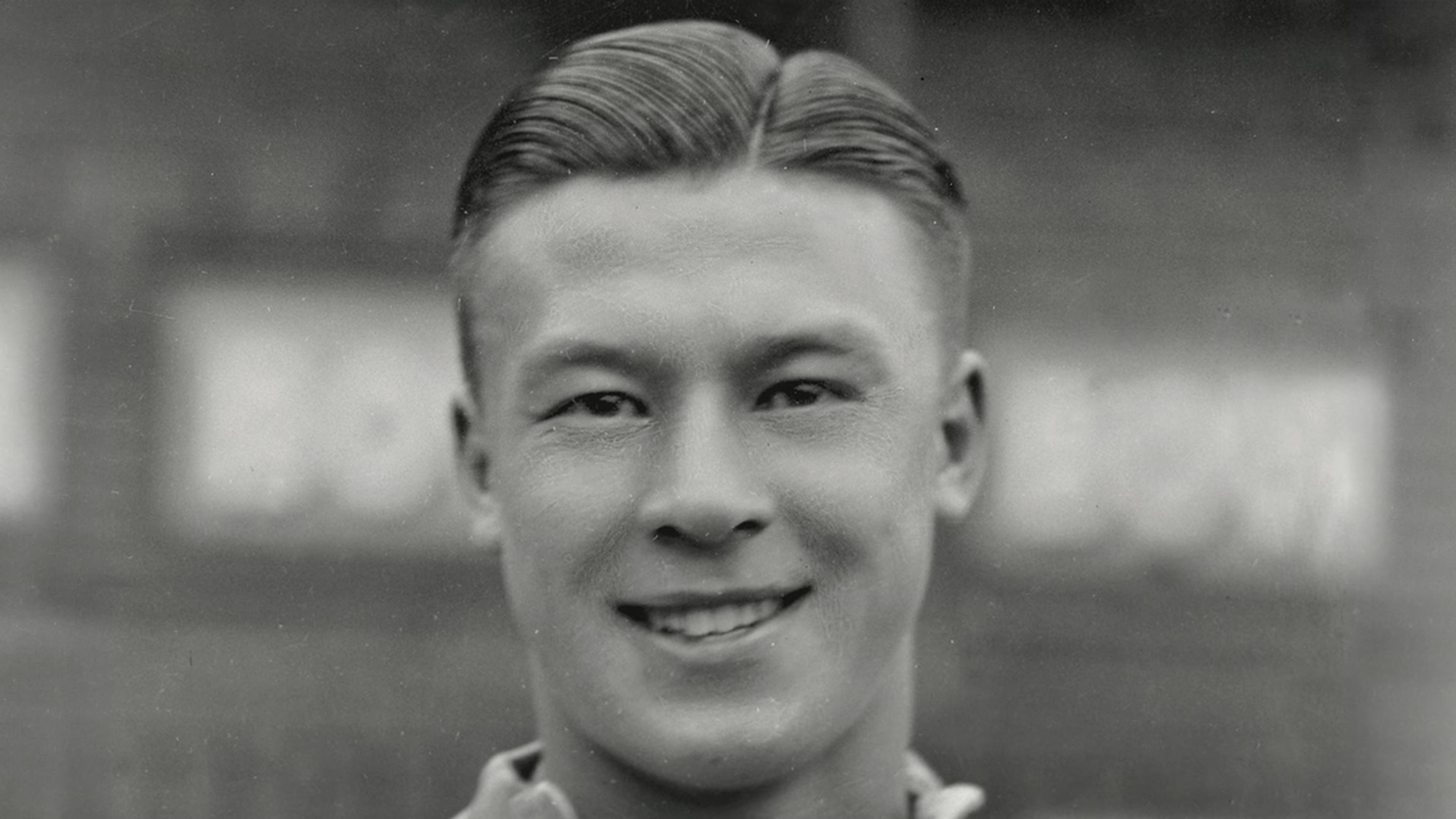
Frank Soo: England’s Pioneering Football Legend
The annals of football history are filled with names etched in gold, their stories told and retold. But some narratives, equally profound, have been obscured by the passage of time. The story of Frank Soo is one such tale—a chronicle of extraordinary talent, shattered barriers, and a legacy that was, until recently, perilously close to being forgotten. He was a maestro on the pitch, a leader revered by teammates and fans, and a trailblazer whose very presence on the field challenged the conventions of his era. This is the comprehensive account of the man who broke football’s colour line for England, a player of sublime skill whose influence stretched from the muddy pitches of pre-war Britain to the technical halls of European football. We will trace his journey from his roots in Liverpool to his historic international cap, his globetrotting managerial career, and his ultimate, poignant disappearance from the mainstream football consciousness, only to be rediscovered by a new generation determined to secure his rightful place in history.
Early Life and Footballing Roots
Frank Soo’s story begins not in a traditional English football hotbed, but in a unique cultural melting pot. He was born in Buxton, Derbyshire, in 1914, the son of a Chinese father, Quan Soo, and an English mother, Beatrice. The family soon moved to Liverpool, settling in the multi-ethnic docklands area. It was here, playing football in the streets with a ball made of rags, that a young Frank Soo first honed the dazzling skills that would become his trademark. His mixed heritage made him a distinctive figure in 1920s and 30s Britain, but his prodigious talent was impossible to ignore, quickly marking him out as a special prospect for the future.
His first foray into organised football came with Prescot Cables, a local non-league side where his performances turned the heads of scouts from much bigger clubs. The defining move of his early career came in 1933 when he signed for Stoke City, then a formidable force in the old First Division. Under the management of Tom Mather, Soo was initially groomed in the reserves, but it was clear his technical ability and visionary passing were destined for the first team. He made his debut and swiftly became an integral part of a Stoke side known as the “Wizards of the Potteries,” a team celebrated for its stylish, attacking football, a philosophy in which a player of Frank Soo‘s elegant ilk could truly thrive.
The Stoke City Maestro
Upon establishing himself in the Stoke City first team, Frank Soo quickly became a fan favourite at the Victoria Ground. Operating as a creative inside-forward, his role was the engine room of the team’s attacking play. He was renowned for his impeccable first touch, incisive through-balls, and an extraordinary understanding of spatial dynamics on the pitch. Soo formed a legendary half-back line with the likes of Joe Johnson and Tommy Sale, a unit celebrated for its blend of defensive solidity and creative flair. His partnership with the great Sir Stanley Matthews, who often operated on the wing, was particularly devastating, with Soo’s intelligent distribution frequently setting the England winger free.
The pre-war Stoke side, with Frank Soo pulling the strings, was a genuine force capable of challenging for the game’s highest honours. He was a key figure as the club mounted a serious title challenge and reached the FA Cup semi-finals, fixtures that drew massive crowds and national media attention. His consistent excellence at the highest level of English club football made it impossible for the national selectors to ignore him, despite any unspoken prejudices that may have existed at the time. It was during this period that the footballing world began to truly appreciate the caliber of player Frank Soo was—a cerebral playmaker whose influence on a match was profound and often decisive.
A Historic International Breakthrough
The pinnacle of Frank Soo‘s playing career in England came on a momentous day in 1942, during the heightened tensions of the Second World War. He was selected to represent England in a wartime international against Wales at Wembley Stadium. This selection was historic, making him the first person of non-European heritage to ever play for the England national team. While wartime caps are not considered official full internationals by today’s records, at the time, these matches were taken with the utmost seriousness and featured the very best available players, representing the ultimate honour for any footballer.
This landmark appearance was not a mere token gesture. Frank Soo‘s selection was earned purely on merit, a testament to his standing as one of the finest midfielders in the country. He performed with his customary composure and intelligence on the hallowed Wembley turf, proving he belonged on that stage. He would go on to make a further eight wartime appearances for England, captaining the side on one occasion and playing alongside other greats of the era. These matches solidified his status as a national icon and a pioneering figure, though the unique circumstances of war would unfortunately rob him of the chance to earn official peacetime caps for his country.
Wartime Service and Its Impact
Like so many of his generation, Frank Soo‘s footballing prime was irrevocably altered by the outbreak of the Second World War. He enlisted in the Royal Air Force, serving as a physical training instructor. During this period, league football was suspended, but the game continued in the form of regional leagues, cup competitions, and charity matches designed to boost public morale. Soo continued to play, turning out for Stoke City, Everton, and Chelsea as a guest player, while also representing his service side, all while fulfilling his military duties.
The war had a dual impact on Soo’s career. On one hand, it denied him what would almost certainly have been his peak years as a professional footballer in a competitive league, potentially including official England caps and major trophies with a powerful Stoke side. On the other hand, his widespread exposure as a guest player and in representative matches for the RAF only enhanced his reputation. Fans across the country witnessed his brilliance firsthand, solidifying his fame beyond just the Potteries. This period cemented his image not just as a talented athlete, but as a dedicated serviceman contributing to the national effort.
Post-War Transitions and Club Journey
Following the conclusion of the war, Frank Soo, now in his early thirties, returned to a football landscape that had changed significantly. He played one more season with Stoke City before embarking on a journey across various clubs. He transferred to Leicester City in 1945, bringing his experience to a new squad, before moving to Luton Town shortly thereafter. His playing style, built on guile and technique rather than raw pace, allowed him to remain effective even as he entered the latter stages of his career. His presence at these clubs was a major draw for supporters who knew they were watching a true artist of the game.
His final playing stops in England were with Chelmsford City, where he combined playing with some early coaching responsibilities, showcasing the direction his future in football would take. This gradual transition from elite player to lower-league veteran and then into coaching was a common path for professionals of his generation. However, for Frank Soo, it was the prelude to a second, even more globetrotting act. The knowledge and sophisticated understanding of the game he had accumulated over nearly two decades as a player were about to be exported across Europe and beyond, beginning an entirely new chapter in his remarkable football life.
The Pioneering Managerial Odyssey
After hanging up his boots, Frank Soo embarked on a managerial career that was, for an Englishman of his time, remarkably international and pioneering. He began in Scandinavia, taking the helm at Danish club Esbjerg fB and later moving to Sweden to manage Örebro SK. His work in Sweden was particularly influential; he is credited with helping to modernise the tactical approach of the Swedish game, introducing more structured training methods and a nuanced understanding of formations and player roles. This success established his reputation as a forward-thinking coach with a valuable footballing intellect.
His managerial journey then took him to Italy, where he served as head coach of the Italian Serie A side Padova in the 1950s—a rare and significant appointment for a British coach in that era. He later had a stint in Norway with Fredrikstad FK. This peripatetic career saw Frank Soo impart his knowledge across different footballing cultures long before such international exchanges became common. He was a true football cosmopolitan, respected for his tactical acumen and his ability to adapt and teach the game in varied environments, from the defensive rigour of Italy to the emerging structures of Scandinavian football.
A Tactical Innovator and Teacher
As a manager, Frank Soo was widely regarded as a deep thinker about the game, an innovator who emphasized technical proficiency and tactical discipline. His experiences as a player in the creative, attacking Stoke City side of the 1930s clearly informed his philosophy, but he blended this with a pragmatic understanding of different systems. In Sweden and Norway, he was seen as a teacher, elevating the local players’ understanding of positional play, passing patterns, and collective defensive responsibility. His methods were considered advanced for the leagues in which he worked.
His foray into Italian football with Padova was his most challenging test, pitting his ideas against some of the most tactically astute minds in the world. While his tenure there was brief, it underscored his reputation for bravery and a willingness to test himself at the highest levels. A former player once noted of his coaching style, “He saw the pitch as a chessboard, and he taught us how to think three moves ahead.” This cerebral approach, a hallmark of his own playing days, became the defining feature of his coaching methodology, influencing a generation of players in the countries where he worked.
The Legacy of a Forgotten Pioneer
For decades after his retirement from the game, the story of Frank Soo faded into relative obscurity. The reasons for this are complex and multifaceted. The lack of official England caps due to the war meant he was absent from the official record books. His mixed heritage, in an era less concerned with documenting diversity, may have also contributed to his story being overlooked by mainstream football historians. Furthermore, his globetrotting managerial career meant he was not permanently associated with one major English club as a legendary figure, causing his profile to diminish at home.
However, the 21st century has seen a magnificent and determined effort to resurrect his legacy. Historians, journalists, and cultural activists have worked tirelessly to piece together his story, leading to a resurgence of interest in his life and achievements. Books have been published, documentaries produced, and campaigns launched to have his contributions formally recognised. This rediscovery has positioned Frank Soo not just as a great player, but as a seminal figure in the history of diversity in British football—a man who broke a significant barrier with immense grace and skill, paving the way for future generations.
Hugo Bachega accent Explained: The BBC Journalist’s Global Voice
Frank Soo in Historical Context
To fully appreciate the significance of Frank Soo‘s career, it is essential to view it through the lens of his time. Britain in the 1930s and 40s was a society where overt racism and xenophobia were commonplace. For a player of Anglo-Chinese descent to not only excel in the national sport but to also represent the national team was a radical and powerful statement. His presence on the field was a quiet but persistent challenge to the prevailing prejudices of the era, demonstrating that talent and character were what truly mattered.
He predated other well-known black pioneers in British football, such as Roy Francis in rugby league or Albert Johanneson in football, by a generation. This context makes his achievements all the more remarkable. Frank Soo navigated this landscape with immense dignity, letting his football do the talking. He faced the pressure of being a trailblazer with a quiet resilience, focusing on his performance and earning the respect of teammates, opponents, and fans through his consistent excellence and professional conduct, thereby normalising diversity in a way few others could at the time.
Comparison of Frank Soo’s Era to Modern Football
The world in which Frank Soo played and coached was fundamentally different from the modern globalised game. The table below highlights some of the key contrasts between his pioneering path and the experiences of a modern multi-ethnic English footballer.
| Aspect of the Game | The Era of Frank Soo (1930s-1950s) | The Modern Football Era (2000s-Present) |
|---|---|---|
| Player Identity & Heritage | A rare anomaly; subject to public curiosity and potential prejudice. | Celebrated and promoted; diversity is often seen as a strength for clubs and the national team. |
| Media Scrutiny | Local press and radio; slower, less intrusive coverage. | 24/7 global media, social media; intense, constant public and private scrutiny. |
| International Football | Wartime matches were major events but not official; travel was difficult and rare. | Highly structured, official FIFA-sanctioned fixtures; global travel is routine. |
| Managerial Opportunities | International roles for British coaches were unusual and pioneering. | A truly global job market; top coaches are expected to have international experience. |
| Tactical Evolution | Relatively slow dissemination of ideas; formations like the WM were dominant. | Rapid, hyper-connected evolution of tactics; data analytics and universal video analysis. |
| Legacy & Recognition | Reliant on local memory and print archives; easily lost over time. | Digitally preserved; statistics, video highlights, and social media ensure player legacies endure. |
Cultural Impact and Symbolism
Beyond his statistical achievements, Frank Soo holds a profound symbolic power in the story of English football. He is a vital figure in the narrative of immigration and integration in Britain. His life demonstrates that the history of the English game is more diverse than has traditionally been portrayed. He represents the countless unsung individuals whose contributions have shaped the nation’s cultural fabric, serving as an inspiration for British East Asian communities today, for whom he is a foundational sporting hero.
His legacy is now being leveraged to promote inclusivity and to challenge stereotypes within football. The rediscovery of his story forces a re-evaluation of the sport’s history, reminding us that talent is universal, even if opportunity has not always been. As one historian aptly put it, “Frank Soo wasn’t just playing football; he was, unwittingly, redefining what it meant to be English.” He embodied a more complex, multi-ethnic national identity on the sports field, long before such concepts were widely discussed or accepted in society.
The Rediscovery and Resurgence
The campaign to restore Frank Soo to his rightful place in football history has gained significant momentum in recent years. This has been driven by a combination of academic research, fan-led initiatives, and growing media interest. The publication of a definitive biography was a watershed moment, providing a detailed and authoritative account of his life for the first time. Supporters’ groups, particularly at Stoke City, have been instrumental in championing his cause, calling for permanent recognition at the club’s stadium.
This grassroots movement has led to tangible results. There have been calls for the FA to award him a posthumous honorary cap to recognise his wartime service for England. Exhibitions have been curated celebrating his life, and his story is now being integrated into educational materials about the history of football and diversity in Britain. This resurgence ensures that the name Frank Soo will not be lost again, and that future generations will understand and appreciate the journey of this extraordinary pioneer who transcended barriers with a football at his feet.
Conclusion
The story of Frank Soo is a rich tapestry woven with threads of sublime skill, unwavering courage, and quiet dignity. He was a footballer of the highest calibre, a leader among men, and a pioneer who carried the hopes of a community long before he could have even realised it. From the vibrant streets of Liverpool to the historic turf of Wembley, and from the technical areas of Scandinavia to the intense atmosphere of Serie A, his life was a testament to the universal language of football. While the circumstances of history conspired to obscure his legacy for a time, the enduring power of his story has ultimately prevailed. Frank Soo is no longer a forgotten man; he is now recognised as a foundational figure, a true legend whose journey forever altered the landscape of English football and whose memory continues to inspire a more inclusive and understanding sporting world.
Frequently Asked Questions
Who was Frank Soo and why is he significant?
Frank Soo was a professional footballer during the 1930s and 1940s, most famous for his time with Stoke City. His profound significance lies in him being the first player of non-European heritage to represent the England national team, a landmark moment in the history of English football that occurred during a wartime international in 1942.
What was Frank Soo’s playing position and style?
He operated primarily as an inside-forward, a creative midfield role akin to a modern-day attacking midfielder or playmaker. Frank Soo was renowned for his exceptional technical ability, intelligent distribution, pinpoint passing, and a sophisticated football brain that allowed him to control the tempo of a game.
Which clubs did Frank Soo play for?
His most iconic club association was with Stoke City, where he was a star of the pre-war “Wizards of the Potteries” side. After WWII, he also played for Leicester City, Luton Town, and Chelmsford City. He also guest-appeared for several clubs, including Everton and Chelsea, during the war years.
Did Frank Soo have a managerial career?
Yes, Frank Soo enjoyed a long and pioneering managerial career after retiring as a player. He managed clubs across Europe, including Esbjerg fB in Denmark, Padova in Italy’s Serie A, and Örebro SK in Sweden, where he is remembered as a tactical innovator and a key influence on the development of their football.
How is Frank Soo’s legacy being preserved today?
After decades of obscurity, Frank Soo‘s legacy is now being vigorously championed through biographies, documentaries, and fan campaigns. There are ongoing efforts to have his contributions formally recognised by the Football Association and his former clubs, ensuring his story as a pivotal pioneer is never forgotten again.
About the Author