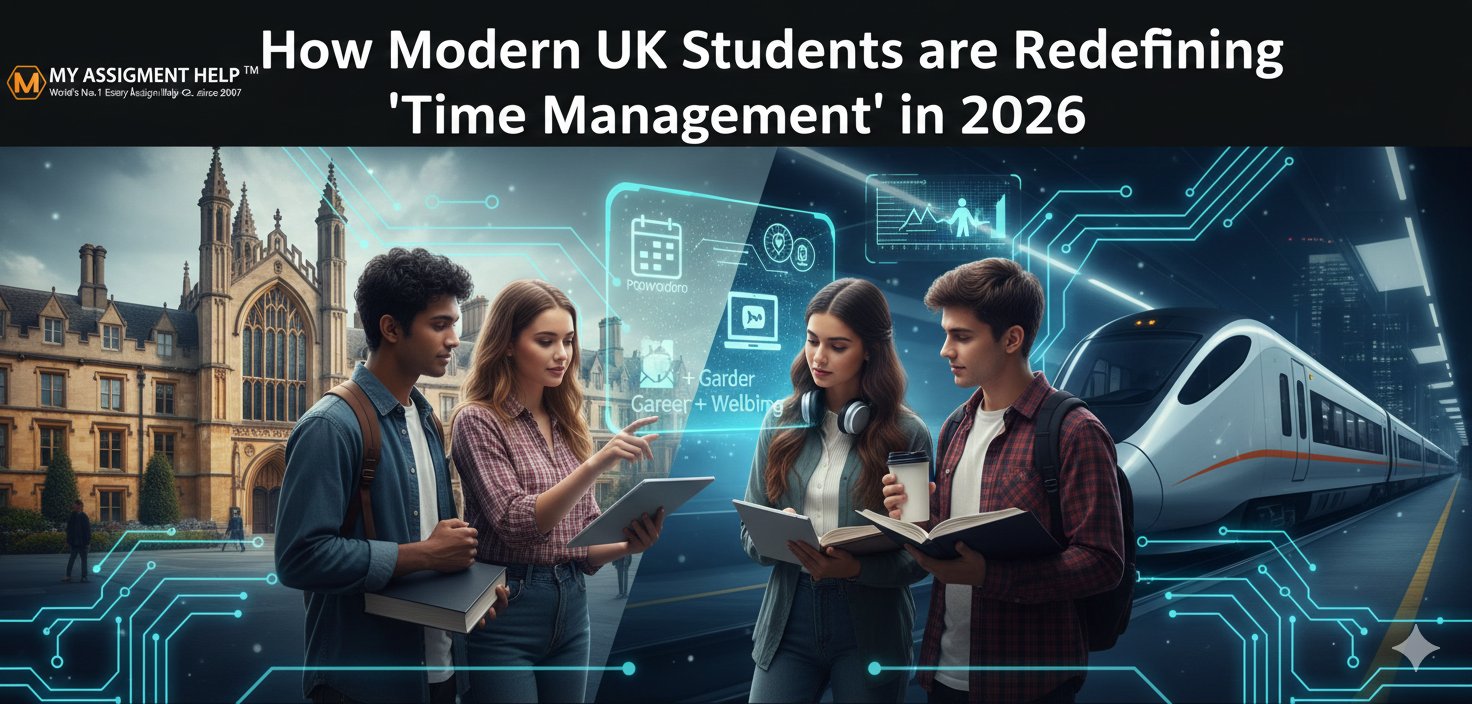
Modern UK Students
The classic image of a UK university student—hunched over a library desk at 3 AM with a lukewarm cup of instant coffee—is becoming a relic of the past. As we move through 2026, the traditional concept of “time management” has undergone a radical transformation.
For the modern British student, managing time is no longer about squeezing more hours into the day; it is about energy management, cognitive load balancing, and the strategic outsourcing of academic pressure. With the rise of the “Side-Hustle Economy,” the integration of Neuro-AI tools, and a heightened focus on mental well-being, the Class of 2026 is rewriting the rulebook on productivity.
The Shift from Chronological to Energy-Based Scheduling
In 2026, the rigid 9-to-5 study block is dead. Data from the Higher Education Policy Institute (HEPI) suggests that 68% of UK students now prefer “asynchronous learning cycles.” Instead of fighting natural circadian rhythms, students are utilizing “Chronotype Scheduling.”
Early birds tackle complex dissertation chapters at 6 AM, while night owls leverage the quiet of the late hours for creative coding or design projects. This shift is supported by the “4-Quarter Day” method, where the day is divided into four distinct blocks, allowing for resets if one quarter proves unproductive. This prevents the “lost day” syndrome that previously plagued students struggling with burnout.
The Rise of Strategic Academic Outsourcing
One of the most significant shifts in 2026 is the pragmatic approach toward academic workload. Modern students view their degree as a project management exercise. They recognize that they cannot be experts in every sub-discipline simultaneously, especially when balancing part-time professional roles or internships in London’s booming tech sector.
When deadlines for minor modules clash with high-stakes final projects, many savvy learners choose to delegate. It is becoming increasingly common for students to pay for assignments to manage their cognitive load effectively. By offloading standard coursework, they can dedicate their “deep work” hours to their primary thesis or career-defining placements. This isn’t about avoiding work; it’s about high-level resource allocation—a skill that is highly valued in the modern UK corporate landscape.
The “AI-Co-Pilot” Integration
By 2026, the debate over AI in education has shifted from “prohibition” to “integration.” UK universities, from the Russell Group to modern institutions, have implemented “Human-AI Collaboration” frameworks.
Students now use AI for:
- Rapid Synthesis: Summarising vast amounts of legal case law or medical journals.
- Drafting Structures: Using generative tools to overcome “blank page syndrome.”
- Personalised Tutoring: AI bots that act as 24/7 Socratic tutors.
However, the human element remains irreplaceable. For instance, when it comes to nuanced argumentative writing or critical analysis, students frequently seek expert essay help to ensure their work meets the rigorous academic standards required for a First-Class degree. This hybrid approach—using AI for speed and human experts for depth—is the hallmark of the 2026 academic strategy.
The Death of Multi-tasking: Monotasking and “Flow State”
In an era of digital distraction, “Monotasking” has become a premium skill. Research from the University of Cambridge highlights that the “switching cost” of moving between social media and academic writing can reduce IQ by 10 points.
To combat this, UK students are adopting:
- Digital Minimalism: Using “dumb phones” or focus modes during study blocks.
- Body Doubling: Using platforms like Focusmate or TikTok “Study With Me” live streams to maintain accountability.
- The 90-Minute Sprint: Based on the Ultradian Rhythm, students work for 90 minutes followed by a 20-minute total brain break (no screens).
Financial Time-Management: The Cost of Living Factor
We cannot discuss time management without mentioning the UK’s economic climate. With tuition fees and living costs in cities like Manchester, Bristol, and Edinburgh at record highs, 74% of students now hold at least one part-time job.
Time management in 2026 is, therefore, a survival tactic. Students are “stacking” tasks—listening to recorded lectures during commutes or using speech-to-text tools to draft ideas while at work. The boundary between “student life” and “professional life” has blurred, making efficiency a non-negotiable requirement rather than a choice.
Key Takeaways
- Prioritise Energy, Not Time: Work with your body’s natural rhythm, not against it.
- Strategic Delegation: Use professional services for lower-priority tasks to focus on core competencies.
- Hybrid Learning: Embrace AI for research but rely on human expertise for critical analysis.
- Deep Work over Busy Work: 90 minutes of focused effort is better than 5 hours of distracted “studying.”
- Mental Health is Productivity: Scheduled downtime is a requirement for long-term academic success.
FAQ Section
Q: Is using academic help services considered cheating in 2026?
A: In 2026, the focus is on “Academic Integrity with Support.” Using services for guidance, model papers, or editing is seen as a legitimate study aid, similar to hiring a private tutor, provided the final submission reflects the student’s own understanding.
Q: How do I manage time if I have a full-time job and a degree?
A: Focus on “Micro-Learning.” Break your syllabus into 15-minute chunks and utilize academic support services to handle heavy-duty research tasks, allowing you to focus on the final synthesis.
Q: What is the most effective productivity app for UK students?
A: Currently, Notion remains the leader for organisation, while AI-integrated tools like Perplexity and specialised academic platforms are essential for research efficiency.
About the Author: Dr. Alistair Thorne
Senior Academic Consultant at MyAssignmentHelp
Dr. Alistair Thorne is an educational strategist with over 12 years of experience in the UK Higher Education sector. Holding a PhD in Educational Psychology from the University of Birmingham, Alistair focuses on how digital transformation affects student learning patterns. At MyAssignmentHelp, he leads a team dedicated to providing bespoke academic support, helping students navigate the complexities of modern university life with integrity and excellence.
References
- HEPI (2025). The Student Academic Experience Survey.
- Office for Students (OfS) – Digital Learning Reports 2025/26.
- University of Cambridge – Cognitive Science Department: The Cost of Task Switching.
- National Union of Students (NUS) – Cost of Living and Student Employment Trends 2026.
About the Author