Some football matches are simply another date on the calendar. Others can divide an entire city before a ball has even been kicked.
You can feel the difference on derby day. Supporters start discussing the fixture weeks in advance. Friends who normally watch football together suddenly find themselves on opposite sides. And for the players, an ordinary league meeting can become one of the most emotionally charged occasions of the season.
For fans following the Premier League, platforms such as matchxi.com make it easier to keep track of upcoming fixtures, team news, predicted lineups and officially confirmed starting elevens. That information becomes particularly interesting ahead of a derby, when every selection decision is likely to attract attention.
But what actually makes a football match a derby? Does it simply involve two famous clubs, or is there something more specific behind the term?
Football Derby Meaning: What Makes a Match a Derby?
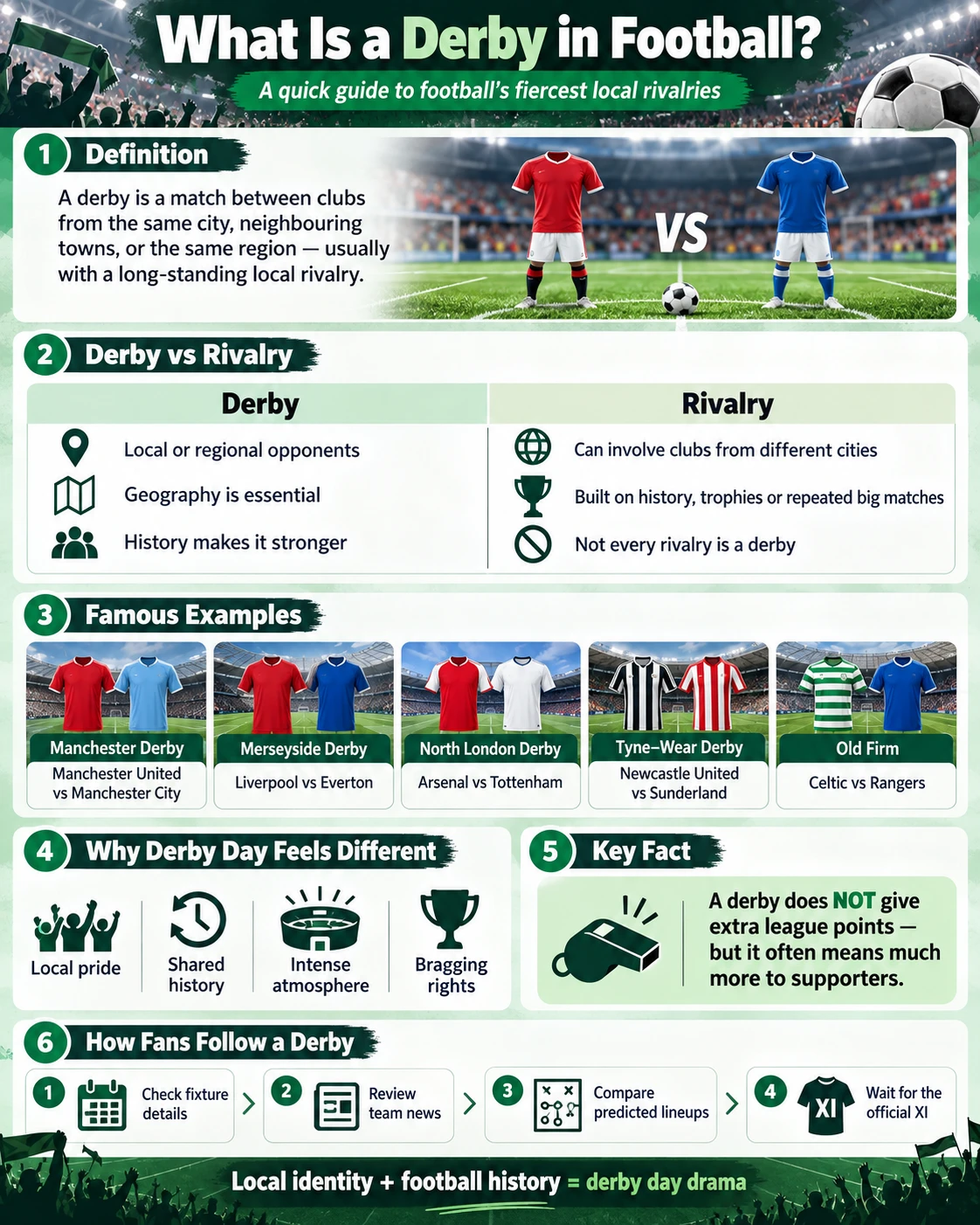
A football derby is a match between two clubs from the same city, neighbouring towns or a shared geographical area, usually with an established local rivalry.
The defining feature is geographical connection. Unlike an ordinary league fixture, a derby often involves teams whose supporters live, work and socialise close to one another.
Consider Manchester United and Manchester City. Both clubs represent Manchester, making their encounters the Manchester derby. Similarly, Liverpool and Everton compete in the Merseyside derby because both clubs are based in Liverpool.
However, proximity is not the whole story.
Derbies become especially significant when years of competition, historical incidents, local identity and memorable results turn geographical neighbours into fierce sporting rivals.
A derby can therefore be both a football match and a reflection of the community surrounding the clubs.
Where Does the Word “Derby” Come From?
The precise origin of the sporting expression remains debated, although several historical explanations have been proposed.
One frequently cited theory connects the term to the famous Epsom Derby horse race, established in the eighteenth century and associated with the Earl of Derby. Another suggests links to traditional football activities in the English town of Derby.
There are also accounts connecting the expression to regional rugby rivalries.
While historians do not agree on a single definitive explanation for how the word entered football vocabulary, its modern sporting meaning is well established.
Today, supporters across the world understand a derby as a meeting between local rivals, regardless of the competition or the size of the stadium.
Five Famous Football Derbies Every Fan Should Know
England and Scotland are home to some of football’s most recognisable local rivalries.
| Derby | Teams | What Makes It Special |
|---|---|---|
| Manchester derby | Manchester United vs Manchester City | Two major clubs representing the same city |
| Merseyside derby | Liverpool vs Everton | A long-standing rivalry between Liverpool neighbours |
| North London derby | Arsenal vs Tottenham Hotspur | Fierce competition between two North London clubs |
| Tyne–Wear derby | Newcastle United vs Sunderland | Regional rivalry between neighbouring areas of north-east England |
| Old Firm derby | Celtic vs Rangers | Historic Glasgow rivalry with deep cultural significance |
These matches demonstrate that derbies are not limited to teams playing in exactly the same neighbourhood.
The Tyne–Wear derby, for example, connects clubs from different nearby cities, while the North London derby involves two clubs from the same part of the capital.
Outside Britain, the Superclásico between Boca Juniors and River Plate in Buenos Aires is another famous example of a local rivalry with international appeal.
Not every derby takes place every season. Clubs may compete in different divisions, but their historical rivalry can remain important to supporters.
Is a Derby the Same as a Football Rivalry?
Not quite.
Every major derby involves some form of rivalry, but not every famous football rivalry qualifies as a traditional local derby.
Take Liverpool versus Manchester United.
Their meetings are among the most significant fixtures in English football, shaped by sporting success, regional identity and decades of competition. However, because the clubs represent different cities, this encounter is generally described as a major rivalry rather than a conventional same-city derby.
A similar distinction applies to Real Madrid and Barcelona.
Their matches are known as El Clásico, one of world football’s most famous rivalries. Yet the clubs are based in different cities, so it is not a local derby in the strict geographical sense.
The distinction matters because football headlines sometimes use “derby” loosely to describe any particularly intense match.
A useful way to remember it is that a derby starts with local identity, while a broader rivalry can develop for many different reasons.
Why Does Derby Day Feel So Different?
Imagine supporting a club whose biggest rivals play only a short journey away.
You might work alongside their supporters, attend the same school or even share a home with someone wearing the opposition’s colours.
When the two teams meet, the result becomes personal in a way that an ordinary league fixture often does not.
There are several reasons derby matches can feel different:
- Local pride: Supporters want their club to claim bragging rights over neighbouring rivals.
- Shared history: Famous goals, controversial decisions and unexpected victories become part of the rivalry’s story.
- Stadium atmosphere: Anticipation, singing and crowd reactions can make the occasion particularly intense.
- Media attention: Local newspapers, broadcasters and social media communities revisit old encounters and debate the upcoming match.
- Emotional pressure: Players and managers know supporters may remember the result long after the final whistle.
Of course, not every derby is dramatic. Some finish goalless, while others are surprisingly one-sided.
But the expectations surrounding them can make even an uneventful match feel significant.
“A league derby may offer the same three points as any other fixture, but local bragging rights can last far longer than the weekend.”
Do Derby Matches Count for More Points?
No. A derby does not carry additional league points simply because of its rivalry.
In the Premier League, a win earns three points, a draw earns one point for each team, and a defeat earns none.
Those rules apply whether the match is a Manchester derby, a North London derby or a meeting between clubs with little historical rivalry.
The difference is emotional and competitive rather than mathematical.
A derby victory might improve confidence, relieve pressure on a manager or strengthen the connection between players and supporters. A defeat can generate frustration, especially when fans must listen to their rivals celebrating.
The wider league situation also matters. A derby between two clubs competing for the title or trying to avoid relegation may have consequences beyond local pride.
And if the rivals meet in a knockout cup competition, progression to the next round becomes the immediate sporting prize instead of league points.
How to Follow a Derby Like a Well-Informed Football Fan
The build-up to a derby can produce a remarkable amount of speculation.
A player misses training. A manager offers a cryptic response during a press conference. Someone shares a possible starting lineup online, and suddenly supporters are convinced a major tactical surprise is coming.
Before accepting every headline, it helps to follow a straightforward matchday routine.
1. Check the fixture and competition
Start with the confirmed match date, kick-off time and venue.
Is it a league match, a cup tie or another competition? That context determines what is at stake and can affect how managers approach the fixture.
2. Separate team news from rumours
An official club update may confirm that a player is unavailable or facing a fitness assessment.
Social media speculation does not offer the same certainty.
Pay attention to when information was published and whether it concerns the upcoming match rather than an earlier fixture.
3. Treat predicted lineups as predictions
Projected starting elevens can help supporters understand possible formations and selection choices.
They are not confirmation of the manager’s decisions.
Even an established first-team player might begin a derby on the bench for tactical or fitness-related reasons.
4. Look for the official team sheet
Once the confirmed starting eleven becomes available, supporters can see who has actually been selected.
That is the point when pre-match speculation gives way to evidence.
The official lineup can also provide clues about the manager’s approach, although the formation shown in a graphic does not necessarily reveal every tactical instruction.
5. Watch the match rather than just the headlines
A derby’s reputation does not guarantee a particular style of football.
Some teams press aggressively from the opening whistle. Others defend patiently, control possession or look for counter-attacking opportunities.
Watching how the two sides actually play often reveals much more than the pre-match predictions.
Can a Derby Change a Club’s Season?
Sometimes, but context is everything.
A derby win late in a title race may prove extremely valuable. A victory over a local rival while fighting relegation can be equally important.
Derbies can also create memorable moments that shape a club’s identity.
A young academy player scoring a decisive goal against a historic rival, for example, could become a favourite with supporters almost overnight.
Nevertheless, it is important not to exaggerate the impact of one result.
Winning a derby does not automatically transform a team’s season, just as losing one does not necessarily indicate a crisis.
League position, performances over multiple matches, injuries and upcoming fixtures remain important when assessing a club’s prospects.
Frequently Asked Questions About Football Derbies
Can teams from different cities play a derby?
Yes. Teams from neighbouring cities or closely connected geographical areas can have recognised local derbies. Newcastle United and Sunderland provide a well-known example.
Is every major football rivalry a derby?
No. The term traditionally refers to local or regional rivals. Some famous rivalries, including Real Madrid versus Barcelona, have their own identities without being local derbies in the strict sense.
Is a football derby connected to Derby County?
Not necessarily. Derby County is a football club named after the city of Derby. The sporting term “derby” is used much more broadly to describe matches between local rivals.
Can a derby take place outside the league?
Absolutely. Local rivals can meet in domestic cups or other competitions. The rivalry remains relevant even when the match is not part of their regular league schedule.
Final Thoughts: More Than Just Another Football Match
The meaning of a football derby is simple: two local rivals meeting on the pitch. But the emotion surrounding the occasion is anything but simple.
Derbies bring together geography, history, community identity and sporting competition. They create memorable moments for supporters and give every generation a new chapter in a rivalry that may have existed for decades.
Whether it is Manchester, Merseyside, North London or Glasgow, the appeal remains remarkably similar.
For the players, it is another match to prepare for and compete in. For supporters, it can be the fixture they look forward to more than any other.
And when the final whistle blows, the result rarely stays inside the stadium.