The transformer architecture, introduced in the 2017 paper “Attention Is All You Need,” fundamentally changed how machines process and generate language. Since then, three distinct architectural families have emerged from it — each optimized for different tasks and use cases.
Understanding the differences between Decoder-only models like GPT, Encoder-only models like BERT, and Encoder-Decoder models like T5 is not just academic knowledge. It is a practical foundation for anyone building, fine-tuning, or deploying language models in real-world applications. For learners pursuing a gen ai training in hyderabad, this comparative study forms a cornerstone of any well-structured curriculum.
The Transformer Foundation
Before comparing architectures, it helps to understand the shared building block: the transformer. A transformer processes text using self-attention mechanisms, which allow the model to consider the relevance of each word in a sequence relative to every other word — regardless of position. This overcomes a key limitation of earlier recurrent neural networks, which struggled to capture long-range dependencies.
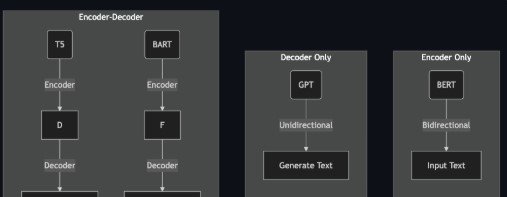
The original transformer consisted of two components: an encoder, which reads and represents input text, and a decoder, which generates output text. Different model families selectively use one or both of these components depending on what they are designed to do.
Decoder-Only Architecture: GPT Models
The GPT (Generative Pre-trained Transformer), developed by OpenAI, uses only the decoder component of the transformer. These models are trained using causal language modeling — predicting the next token based solely on the tokens that came before it. The attention mechanism is masked so the model cannot look ahead in the sequence.
This autoregressive design makes GPT-style models naturally suited for text generation tasks: writing, summarization, dialogue, code generation, and more. Models like GPT-4, Claude, and LLaMA follow this architecture.
Strengths:
- Excellent at open-ended text generation
- Scales effectively with more parameters and data
- Strong few-shot and zero-shot performance
Limitations:
- Not optimal for tasks requiring deep bidirectional understanding of input text
- Computationally heavier at inference for long sequences
Encoder-Only Architecture: BERT Models
BERT (Bidirectional Encoder Representations from Transformers), developed by Google, uses only the encoder component. Unlike GPT, BERT reads the entire input sequence simultaneously in both directions. It is trained using masked language modeling — randomly masking tokens in a sentence and training the model to predict them based on surrounding context.
This bidirectional attention makes BERT exceptionally good at understanding and representing language rather than generating it. It excels at classification, named entity recognition, sentiment analysis, and question answering where a fixed input needs to be deeply understood.
Strengths:
- Rich contextual representations of input text
- Strong performance on classification and retrieval tasks
- Lightweight inference for many NLP applications
Limitations:
- Cannot generate text natively
- Less effective for generative or seq-to-seq tasks
Encoder-Decoder Architecture: T5 and Seq2Seq Models
T5 (Text-to-Text Transfer Transformer), also from Google, uses both the encoder and the decoder. This architecture is designed for sequence-to-sequence tasks — where the model takes one piece of text as input and produces a different piece of text as output.
T5 reframes all NLP problems as text-to-text tasks. Whether it is translation, summarization, or question answering, both the input and output are treated as raw text strings. The encoder processes the input and builds a rich representation; the decoder then generates the output token by token conditioned on that representation.
Strengths:
- Versatile across a wide range of tasks
- Well-suited for translation, summarization, and structured generation
- Clear separation between understanding (encoder) and generation (decoder)
Limitations:
- More complex to train and deploy than single-component models
- Higher memory requirements compared to encoder-only models
Choosing the Right Architecture
Selecting an architecture depends entirely on the task at hand. For open-ended generation or conversational AI, a decoder-only model is the natural choice. For understanding and classifying fixed text, an encoder-only model is more efficient. For tasks that require transforming one text into another — translation, summarization, or data-to-text generation — an encoder-decoder model offers the most structured approach.
This kind of architectural reasoning is precisely what a well-designed gen ai training in hyderabad should teach. Bangalore’s technology sector demands engineers who can make informed choices about model selection, not just plug-and-play with existing APIs. A solid understanding of these foundations enables practitioners to fine-tune the right model for the right problem and deploy it efficiently.
Conclusion
GPT, BERT, and T5 represent three distinct philosophical approaches to language modeling — each with clear strengths and appropriate use cases. Decoder-only models generate; encoder-only models understand; encoder-decoder models transform. Mastering these differences is essential for building reliable, production-ready AI systems. For anyone pursuing a gen ai training in hyderabad, this comparative knowledge is not optional — it is the foundation on which every advanced topic in the field is built.