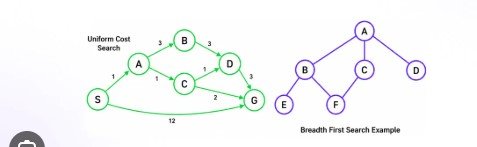
Uniform Cost Search (UCS) is a classic search algorithm which finds the lowest cost path from a start state to a goal state. It’s not a “how close are we to the goal” kind of search, it’s a “what is the cost of the path so far” kind of search. The rule is that you simply expand the node with the lowest total cost and that is what makes it so reliable for problems where the actions have different costs (route planning, logistics, etc. are all examples of this). If you’re looking at search algorithms as part of your AI Training in Bangalore, UCS is a very clear example of how a search that is aware of cost will find the optimal solution.
How Uniform Cost Search Works
At its heart there’s a frontier (also known as an open list) which contains the nodes that have been discovered but not yet expanded. Each node in the frontier has a value g(n) associated with it which is the total cost of the path from the start node to that node.
UCS follows a repeating loop:
- Start by putting the initial node in the frontier with g(start) = 0.
- Pick (and remove) the node in the frontier which has the smallest g(n).
- If that node is the goal then we’re done, that’s the cheapest path to the goal.
- Otherwise expand the node and generate its neighbours.
- For each neighbour, calculate its new path cost and add it to the frontier if it’s promising.
The ‘pick the smallest g(n)’ step is what defines it. In practice UCS will use a priority queue (a min-heap) so that the lowest cost node on the frontier can be retrieved efficiently.
A useful way of thinking about UCS is that it’s exploring outwards in cost layers rather than depth layers. If the long route is cheap and the short route is expensive then UCS will go for the cheap one.
Why UCS Finds the Optimal Path
UCS is both complete and optimal under the standard assumptions.
Completeness: UCS will find a solution if one exists (provided that every step cost is >= some small positive value – or at least non-negative with a bit of care). This stops it getting stuck in an infinite loop of zero cost cycles.
Optimality: UCS is optimal when all step costs are non-negative. The reason for this is pretty obvious really: the first time UCS removes a goal node from the priority queue it will be the cheapest way of getting to that goal. If there were a cheaper path then UCS would have expanded the cheaper partial paths earlier on (they would have had a lower g(n) value).
This is also why UCS is so closely associated with Dijkstra’s algorithm. In fact for graph search with non-negative edge weights UCS is effectively Dijkstra’s algorithm: it builds up a set of best known costs and progressively verifies the cheapest path to each node that it expands.
Complexity and Implementation Tips
The strength of the UCS ‘guaranteed cheapest path’ is of course at the expense of computational cost.
Time complexity: in the worst case UCS can end up expanding a large part of the state space (particularly when there are many different paths of similar cost). The runtime will depend on the branching factor, the distribution of the edge weights and how far the cheapest solution is in terms of cumulative cost.
Space complexity: UCS will store all of the frontier nodes in memory. This can get quite large as it has to keep all the alternatives in memory until it is certain that they are not part of a cheaper path.
Practical implementation points:
- Use a priority queue keyed on g(n).
- Track the best known cost to each node (often referred to as dist or cost_so_far). If you come across a cheaper path to a node that you’ve already seen, then update it.
- Don’t go back and reprocess nodes that have already been confirmed (the closed set) but do so with care. Only mark a node as final when you actually pop it from the priority queue having arrived at it via the lowest known cost.
- Ensure non-negative step costs. If there are any negative costs then UCS no longer guarantees optimality and other approaches are required.
These are the sorts of things that come up in interviews and in project work and are invariably reinforced in an AI training in Bangalore where the students are actually going to be implementing search algorithms on weighted graphs.
When UCS Is the Right Choice
UCS is a strong option when:
- Costs are different for each action (fuel, time, tolls, risk, money).
- You need a guaranteed optimal solution rather than a fast approximate answer.
- The problem can be viewed as a weighted graph (or state space).
However if you have a good heuristic that gives you an estimate of the remaining cost to the goal then you can get to the goal much faster with A* by combining g(n) with that informed estimate. UCS is effectively A* with a zero heuristic (i.e. it’s safe) but can sometimes be slower.
Still, UCS is fundamental. It teaches you a vital lesson in that optimal decision making requires you to take account of real costs rather than just the number of steps. It’s a core topic in a number of curricula, including an AI Training in Bangalore which is specifically about search and planning.
Conclusion
Uniform Cost Search expands the node with the lowest path cost first and is therefore a very reliable method for finding the cheapest path in a weighted problem. Its completeness and optimality (assuming non-negative step costs) are the reasons it crops up so frequently in AI, robotics and network routing. It may take longer and use more memory than a heuristic approach, but it is a very clean and rigorous method for cost aware search and it is absolutely essential to have a firm grasp of it whether you’re doing it in a professional context or as part of an AI training in Bangalore.