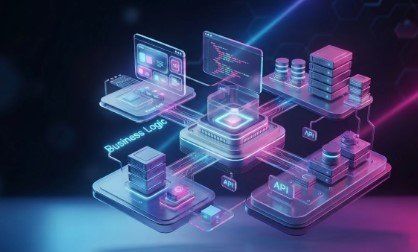
Most developers start out with CRUD (Create, Read, Update, Delete) as that’s the fundamental basis of any data driven application. As the applications grow, CRUD becomes a bottleneck and performance issues start to emerge. Event driven architecture is the answer to that.
Once you’re comfortable with CRUD the next logical step for anyone doing full stack Java dev training is to look at event driven systems. Getting a handle on that concept is the way to go if you want to be able to design scalable, loosely coupled and production ready systems.
What Is Event-Driven Architecture?
Event Driven Architecture (EDA) is where components communicate by sharing events. An event is an action, an order for example or a payment. It’s different to CRUD where Service A would call Service B directly. In EDA Service A publishes an event to a broker and Service B then responds to that event independently. That’s the separation of concern.
By reducing coupling event driven architectures lead to a more resilient system with services able to operate independently and fail gracefully. They also provide the ability to scale, with the system able to scale to meet demand by simply having events distributed to a number of consumers. That’s what makes them a professional grade system rather than a beginner’s system in terms of resilience and scalability as the load increases.
Core Components of an Event-Driven System in Java
Building an event driven system in Java involves a number of technologies and concepts.
Message Brokers
A message broker routes events. Kafka is ideal for high throughput data, RabbitMQ is good for task queues and reliable messaging.
Producers and Consumers
A producer creates events; a consumer listens for and acts on them. In Java, Spring Boot makes both annotation based configuration and integration very easy.
Event Schema and Contracts
A clear event schema is absolutely essential. Avro and JSON Schema are both excellent examples of tools that enforce a schema and prevent breaking changes. Event schemas should be treated as public contracts.
Idempotency and Error Handling
Consumers must be able to deal with duplicate events. Network failures can result in duplicates so you need idempotent consumers that produce the same result every time.
Implementing Event-Driven Patterns with Spring Boot
Spring Boot supports event driven development via Spring Kafka and Spring AMQP. The workflow is to define an event class.
- Configure a Kafka producer in your service layer to fire an event whenever a business action takes place.
- Create a consumer in a separate service using the @KafkaListener annotation to react to those events.
- Add support for dead-letter queues so that failed messages aren’t just silently dropped.
Spring also provides application level events via the ApplicationEventPublisher to decouple components within a single application prior to the addition of a broker.
Full stack Java training covers these integrations, taking the developer from theory to practical, real world implementation.
When to Use Event-Driven Architecture
Event driven systems add a whole layer of complexity in the form of brokers, queues and eventual consistency. They’re best used when a number of services are all acting on the same event.
- You need to decouple the services that are currently sharing a database.
- You’re processing a high volume of data asynchronously.
- You want to audit all state changes via an event log.
For simple internal apps CRUD may still be the right answer. Use EDA only if you have a very clear reason for doing so.
Conclusion
Moving beyond CRUD is a major step in a developer’s journey. Event driven architecture allows you to build systems that scale, are fault tolerant and can evolve without causing a domino effect of failures across the services. Java is a great platform to do this with (Spring Boot, Kafka etc. are all very mature). The right kind of structured full stack Java developer training that includes distributed systems will give you the skills to actually build software that works in the real world rather than just in a demo. Getting to the point where you can architect and build event driven systems is a huge differentiator for a developer.