Modern organisations generate data from everywhere: apps, websites, sensors, CRM systems, call logs, PDFs, images, and clickstreams. Much of this information arrives in messy formats and at high volume. A data lake is designed for this reality. Instead of forcing every dataset into a strict structure upfront, a data lake stores raw data first and supports many ways of shaping it later for analytics, reporting, and machine learning. For learners exploring advanced data systems through a data science course in Chennai, understanding data lake architecture is a practical step towards building real-world data platforms.
What a Data Lake Really Is (and What It Is Not)
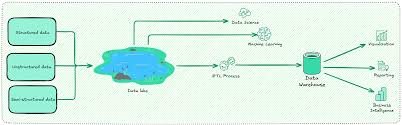
A data lake is a central storage repository that can hold vast amounts of raw data—structured, semi-structured, and unstructured—at any scale. The defining idea is “store now, model later.” This is often called schema-on-read, meaning structure is applied when the data is accessed for a use case.
A data lake is not the same as a traditional data warehouse. Warehouses are typically optimised for curated, structured data and consistent reporting. Data lakes are broader and more flexible. They can support exploration, data science experiments, and diverse workloads. However, flexibility can become a weakness if governance is ignored, leading to the well-known “data swamp” problem where data exists but cannot be trusted or found.
Core Building Blocks of Data Lake Architecture
Ingestion Layer: Getting Data In Reliably
Ingestion is how data enters the lake. Common ingestion patterns include:
- Batch ingestion: daily exports from business systems, logs, or files.
- Streaming ingestion: near-real-time events such as clickstreams, IoT telemetry, or transaction streams.
- CDC (Change Data Capture): incremental updates from databases without full reloads.
A well-designed ingestion layer validates basics (like file integrity and expected columns) and captures metadata (source system, load time, data owner). This makes downstream operations safer and easier to debug.
Storage Layer: Durable, Scalable, Low-Cost
Most data lakes use object storage because it scales economically and can store any file type. The storage layer usually organises data into zones:
- Raw zone: data stored as-is, with minimal transformation.
- Cleansed/standardised zone: data is corrected, de-duplicated, and aligned to common formats.
- Curated zone: analytics-ready datasets designed for specific business domains or models.
Many teams follow a “medallion” pattern (bronze/silver/gold) to make these stages clear. The key is consistency: everyone should know where raw data lives, where quality checks occur, and where trusted datasets are published.
Processing Layer: Turning Raw into Useful
Processing includes cleaning, enrichment, joins, aggregations, and feature generation for ML. This layer can support multiple compute approaches depending on the use case:
- Transforming large files in batch
- Running incremental pipelines
- Building feature datasets for model training
- Creating data products for reporting
Crucially, processing should be repeatable. Pipelines must be versioned, monitored, and designed so that results can be reproduced. This is where many architectures fail: transformations happen in ad-hoc scripts, and no one can explain how a dataset was created.
Consumption Layer: Serving Analytics and ML
A data lake becomes valuable only when people can use it. Consumption patterns include:
- BI dashboards using curated tables
- Data science notebooks exploring cleansed datasets
- ML pipelines training models from feature-ready data
- Data sharing across teams through governed access
For professionals taking a data science course in Chennai, it helps to connect architecture to outcomes: a strong consumption layer reduces time spent searching for data and increases time spent solving business problems.
Governance, Security, and Metadata: Preventing the Data Swamp
Without governance, data lakes degrade quickly. Governance is not just policy—it must be operational.
Key governance practices include:
- Data catalogue and searchable metadata: users must discover datasets, owners, and definitions.
- Access control: role-based access, least privilege, and sensitive data handling.
- Data quality checks: validations for completeness, freshness, duplicates, and outliers.
- Lineage tracking: knowing which pipeline produced a dataset and which sources were used.
- Retention policies: controlling how long raw data and derived datasets are kept.
Security must be built in from the start. Encrypt data at rest and in transit, log access, and classify sensitive fields. The goal is to make compliance routine rather than a last-minute scramble.
Design Best Practices and Common Mistakes
Best Practices
- Use open, efficient file formats for analytics-ready zones to improve performance and reduce costs.
- Partition data sensibly (for example by date or region) to speed up queries.
- Standardise naming and folder conventions so teams can navigate the lake without tribal knowledge.
- Treat curated datasets as products with owners, documentation, and SLAs.
Common Mistakes
- Dumping files into storage with no metadata or ownership
- Mixing raw and curated data in the same location
- No monitoring for pipeline failures or data freshness
- Overbuilding a “perfect” architecture before delivering any usable datasets
A practical way to avoid these pitfalls is to define a small set of high-value use cases (like churn prediction or customer segmentation), then build the minimum lake structure needed to support them.
Conclusion
A data lake architecture is a flexible foundation for storing raw, high-volume data and converting it into trusted datasets for analytics and machine learning. The strongest designs combine scalable storage with disciplined ingestion, repeatable processing, and strong governance. When built well, the lake accelerates decision-making and experimentation without sacrificing control. If you are strengthening your fundamentals through a data science course in Chennai, data lake architecture is worth mastering because it sits at the centre of how modern data teams store, manage, and operationalise data at scale.