Polycarbonate roofing sheets without UV protection turn yellow and become brittle. They fail structurally within two to five years of outdoor installation.
On the contrary, quality sheets with co-extruded UV protection last 10 to 25 years under the same conditions. Understanding how that protection works, what to look for when buying, and how to verify the rating on the sheet is important.
Why Polycarbonate Needs UV Protection
Polycarbonate is a remarkable material in almost every respect. It is up to 200 times stronger than glass at equivalent thickness and far easier to cut and install. Its one genuine vulnerability is ultraviolet radiation.
UV radiation breaks down the polymer chains that give polycarbonate its strength and clarity. Without protection, this process (called photodegradation) causes the sheet to yellow progressively, lose impact resistance, and eventually become brittle enough to crack under normal load. In the UK, even with lower UV intensity than tropical climates, unprotected polycarbonate shows visible degradation within two to three years of outdoor installation.
A complete roofing system using quality polycarbonate glazing bars alongside UV-protected sheets ensures the entire installation resists degradation.
What UV degradation looks like in practice:
● Progressive yellowing that reduces light transmission through the sheet
● Surface crazing – fine surface cracks that appear across the sheet face
● Increased brittleness under impact that would leave a new sheet undamaged
● Reduced structural performance across the roof span
How Co-Extrusion UV Protection Works
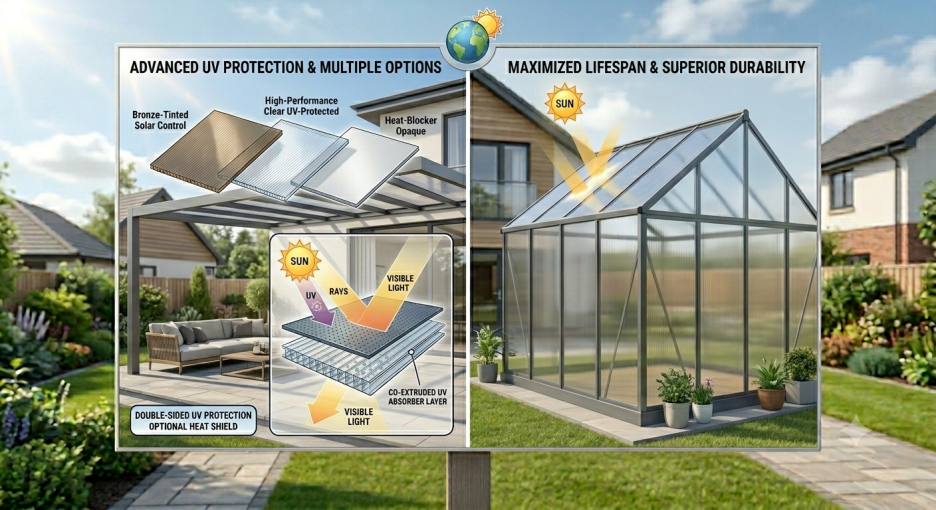
The most effective and durable form of UV protection in UV resistant polycarbonate sheets is co-extrusion. This is not a coating applied to the surface after manufacture. It is a layer of UV-stabilised polycarbonate extruded simultaneously with the main sheet body, becoming a permanent part of the material structure.
During the co-extrusion process, a thin layer of UV-absorbing polycarbonate, typically 50 microns thick, is extruded onto the weather-facing surface of the sheet in the same production run. The two layers bond at the molecular level during extrusion. The result is a UV protection layer that cannot peel, scratch away, or delaminate over time because it is the same material as the sheet itself, not a separate treatment.
How co-extrusion compares to surface coatings:
| Protection Type | Application Method | Durability | Risk of Failure |
| Co-extruded UV layer | Part of the sheet structure | Lasts the sheet’s full lifespan | None – cannot delaminate |
| Surface coating | Applied after manufacture | Degrades over 3 to 7 years | Peeling, flaking, uneven protection |
| No protection | None | Sheet fails within 2 to 5 years | Yellowing and brittleness certain |
Polycarbonate glazing bars and end closures used alongside UV-protected sheets should also be UV-stabilised. A protected sheet with unprotected accessories creates weak points at the joins where degradation begins first.
What a UV Protection Rating Actually Means
The polycarbonate UV protection rating on a sheet specification refers to the percentage of UV radiation blocked by the protective layer. Quality roofing-grade polycarbonate typically blocks 99% or more of UV-A and UV-B radiation.
UV spectrum and what each part does:
| UV Type | Wavelength | Effect on Polycarbonate |
| UV-A | 315 to 400 nm | Primary cause of yellowing and surface degradation |
| UV-B | 280 to 315 nm | Causes brittleness and structural weakening |
| UV-C | Below 280 nm | Largely absorbed by atmosphere, minimal ground-level impact |
A sheet rated at 99% UV blocking stops virtually all UV-A and UV-B radiation from penetrating the material. This rating should appear in the technical datasheet for any sheet you are considering. If a supplier cannot provide a UV transmission specification, the protection level is unverified.
UV Protection in Solid vs Multiwall Sheets
UV protection works the same way across both main polycarbonate formats, but the practical implications differ slightly depending on which sheet type is being used.
Solid polycarbonate roofing sheets are single-layer panels without hollow chambers. UV protection is co-extruded onto one or both faces depending on the product specification. UV2 protection, co-extruded on both faces is available for applications where reflected UV from below the sheet is also a concern, such as pool enclosures and highly reflective environments.
Polycarbonate roof sheets in multiwall format have the UV protection layer on the top face only; the weather-facing surface. The underside does not need protection because UV radiation travels from above. The protective layer is clearly indicated in most quality multiwall products by a printed edge tape or marking that shows which face should face upward during installation. Installing a multiwall sheet upside down removes the UV protection from the weather-facing surface and exposes the unprotected face to direct radiation.
Critical installation check for multiwall sheets:
● Confirm which face carries the UV protection before installation begins
● The UV-protected face must face the sky
● Most quality sheets carry a printed indicator on the protective film or edge tape
● Installing upside down voids the UV performance and the manufacturer warranty
UV Blocking Roofing Panels UK: What to Look for When Buying
UV blocking roofing panels UK suppliers should be able to provide clear technical documentation for any sheet in their range. These are the specific things to confirm before purchasing.
Documentation to request:
● UV transmission specification confirming percentage of UV blocked
● Confirmation that UV protection is co-extruded rather than surface coated
● Manufacturer warranty covering yellowing and UV degradation
● Whether UV protection covers both faces or the weather face only
Red flags when buying polycarbonate roofing:
● No UV transmission data available from the supplier
● Warranty that excludes yellowing or discolouration
● Unusually low price compared to market rate for equivalent thickness
● No clear marking on the sheet indicating which face is UV protected
Quality clear polycarbonate sheets for roofing applications carry a minimum 10-year manufacturer warranty against yellowing when correctly installed. Some premium products carry 15-year warranties. A sheet without a stated warranty against discolouration almost certainly lacks adequate UV protection.
How UV Protection Affects Light Transmission Over Time
One of the most practical benefits of quality UV protection is stable light transmission across the sheet’s service life. A clear polycarbonate sheet transmits over 88% of visible light at installation. A quality UV-protected sheet maintains that transmission level throughout its rated service life because the polymer structure is not degrading.
An unprotected sheet starts at the same transmission level but yellows progressively. Yellowing reduces light transmission directly. For a greenhouse, carport, or garden room where natural light is the reason the polycarbonate was specified, that reduction defeats the purpose of the material.
Solid polycarbonate roofing sheets in clear finish with quality UV protection maintain their optical clarity for the duration of the warranty period when installed and maintained correctly. This is the specification worth prioritising when natural light transmission is a primary requirement of the project.
Maintaining UV Protected Polycarbonate
UV protection does not require special maintenance, but the sheet surface does benefit from regular cleaning to prevent biological growth and atmospheric deposits from accumulating on the UV layer.
Maintenance routine for UV protected polycarbonate roof sheets:
● Clean with warm soapy water and a soft cloth or sponge twice a year
● Never use abrasive cleaners or scouring pads that scratch the UV layer
● Never use solvent-based cleaners that degrade the polycarbonate surface
● Remove debris promptly to prevent moisture retention against the sheet surface
● Check end closures and glazing bars annually for integrity
Polycarbonate roof sheets cleaned regularly with appropriate products maintain their appearance and UV performance across their full service life. The UV layer itself requires no reapplication or treatment as it is a permanent part of the sheet structure.
For the full range of UV-protected polycarbonate roofing sheets in multiwall and solid formats, visit thepolycarbonateroofing.co.uk.