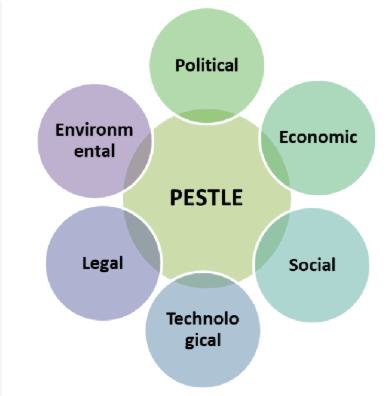
No matter how big an organization is or what industry it is in, it has to function within a wider external environment that it cannot completely control. Changes in the economy, alterations in regulations, and shifts in consumer behavior all influence the conditions in which businesses have to operate. In order to cope with this complexity, strategists use PESTLE analysis, a structured approach that looks at six aspects of the macro environment: Political, Economic, Social, Technological, Legal, and Environmental. It is a fundamental ability in the field of strategic management and one that is increasingly expected of professionals who are taking a business analytics course in Bangalore.
What Is PESTLE Analysis?
PESTLE is an acronym that stands for:
- Political – Government policies, trade regulations, political stability
- Economic – Inflation, GDP growth, interest rates, unemployment
- Social – Demographics, cultural trends, consumer attitudes
- Technological – Innovation, automation, digital infrastructure
- Legal – Employment law, consumer protection, industry regulations
- Environmental – Climate change, sustainability standards, resource availability
While internal audits evaluate a company’s capabilities, PESTLE looks exclusively at external factors. The reason for its existence is to enable leaders to identify opportunities and threats within the macro environment prior to making long-term decisions regarding market entry, product development, or investment planning.
Why PESTLE Matters for Long-Term Strategy
While short-term planning can handle minor shocks, long-term strategy must account for structural changes in the external environment. A company that neglects changing regulations or demographic trends might discover that its whole business model is under threat within ten years.
In the case of the energy sector, companies which had not kept up with the increasing focus on renewable energy policies ended up with heavy compliance costs and suffered damage to their reputation as environmental regulations became more stringent around the world. Conversely, those firms that picked up on the political and environmental signals from the start were able to change their strategies, obtain government incentives, and achieve a competitive edge in the market.
Using a PESTLE analysis allows organisations to see these gradual yet important changes before they turn into crises. It prompts leadership teams to go beyond looking at quarterly results and to take into account the major forces that will shape competitive conditions over the next five to ten years.
How to Conduct an Effective PESTLE Scan
A PESTLE analysis is most useful when it is carried out in a systematic way and is directly linked to strategic decisions. The following is a practical method:
The first step is to define the scope by making it clear whether the scan relates to a particular geography, industry, or business unit; for example, a retail company going into Southeast Asia will have to consider different factors from a domestic healthcare provider.
In step 2 you should collect reliable data, using government publications, industry reports, academic research and economic databases and make sure that you do not depend on a single source for any aspect.
In step 3 you need to evaluate the possible impact and the likelihood. Since not all external factors are of equal importance, assess each one according to how much it could affect the business and how probable it is to occur over the strategic time frame.
In step 4 you should link the findings to strategy since the results of a PESTLE scan should have a direct bearing on decisions relating to market positioning, resource allocation and risk management. Factors listed that have no strategic implication are of little value.
It is important to carry out regular reviews since the macro environment is constantly changing and a PESTLE analysis carried out in one year could become partly outdated within two years, so incorporate periodic reviews into the strategic planning process.
PESTLE in the Context of Business Analytics
Today more and more businesses are using data as a means of carrying out PESTLE scanning. Analytics tools assist companies in monitoring consumer sentiment, modelling economic scenarios, and spotting regulatory patterns in different markets. It is precisely through the combination of qualitative strategic thinking with quantitative data capabilities that PESTLE becomes so much more powerful.
The professionals who sign up for a business analytics course in Bangalore acquire just this type of practical thinking. They are taught to combine approaches such as PESTLE with data-driven tools in order to aid decision-making based on evidence in competitive situations. Since cities such as Bangalore have a high density of technology companies and consulting firms, they provide a particularly pertinent real-world setting for examining macro environmental forces in operation.
Conclusion
A PESTLE analysis should not be carried out just once; it is an ongoing activity which ensures that leadership teams remain aware of the conditions in the wider environment. If organisations systematically look at the political, economic, social, technological, legal, and environmental factors, they will be able to anticipate disruption, spot opportunities, and create strategies that are resilient over the long term. Regardless of whether you are a student, a consultant, or a senior executive, becoming skilled at external scanning will improve your strategic thinking and increase your value in any professional context.