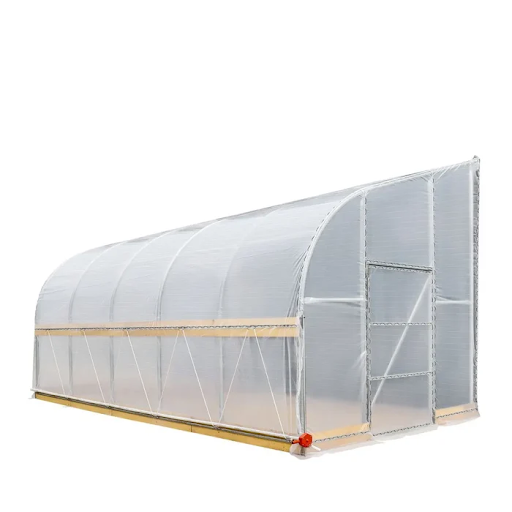
The wall is not just something to bolt to
Anyone planning a backyard growing space in late summer is really planning for next spring, and the first decision is whether the structure stands alone or leans against something. A lean-to greenhouse takes the second path, and the wall it borrows turns out to do far more work than simply holding one end up.
A freestanding structure has to defend itself on four sides against wind, cold, and heat loss, while a lean-to greenhouse only defends three. Attaching one long side to a house or a garage removes an entire wall from that job and hands it to a building that was already insulated and already standing there.
A masonry wall stores heat and gives it back at night
The real gain is thermal rather than structural. Brick, stone, and concrete absorb sunlight through the afternoon and hold that warmth in the material itself, then release it slowly once the air temperature outside begins to drop.
That makes the shared wall a heat battery working on a daily cycle. A lean-to greenhouse against masonry runs noticeably warmer overnight than a freestanding one of the same size, which is exactly when a cold snap does its damage to seedlings.
Orientation is the decision that cannot be undone
Because the structure only has three exposed sides, which direction it faces matters far more than it would for a freestanding tunnel. The glazing collects light from one arc of the sky rather than from all around.
A south facing wall is the one worth using, since it receives sun through the whole of the short winter day. A north facing wall puts the growing space in permanent shadow, and no amount of good glazing recovers from that starting point.
Three walls instead of four is a real saving
Building a lean-to greenhouse removes one side entirely, along with its frame, its cover, and the foundation under it, and that is before counting the labor of putting all three together on a weekend.
The footprint changes too. A ten by twenty structure against a wall occupies a strip of yard rather than a block in the middle of it, which is why this format suits narrow suburban lots where a freestanding tunnel would dominate the space.
The house is right there, which is more useful than it sounds
Water and power are the two services a growing space always ends up wanting, and both of them already terminate at the wall the structure is attached to.
A gardener outside Denver ran a hose bib and an outdoor outlet through the same wall her lean-to greenhouse leans on, which took an afternoon rather than the trenching a structure at the back of the yard would have needed.
Attaching to a building brings its own obligations
The joint where the structure meets the wall is the one place water will find if it is done casually. Flashing that seam properly is what keeps runoff from the greenhouse roof out of the wall behind it.
Ventilation also matters more in a lean-to greenhouse than on an open tunnel. With one side sealed against a building, air has to move through the three remaining sides, or the space overheats badly on the first genuinely hot afternoon.
A clear film cover is chosen for light, not strength
The cover is a clear film rather than rigid panels, and that choice is about transmitting as much light as possible into a space receiving sun from one direction only. Tinted material would cost exactly the light the orientation was chosen to capture.
What to settle before the frame goes up
• Face it south: north walls stay in shadow
• Flash the seam: keep runoff out of the wall
• Plan the vents: one side is sealed already
• Check the services: water and power are close
Where leaning on a wall wins and where it costs
• Strength: borrows warmth from a masonry wall
• Strength: cheaper and smaller than a free structure
• Limit: orientation is fixed by the building
• Limit: the attachment point must be sealed
Weighed against a freestanding tunnel, this format gives up the freedom to choose where the sun falls, and returns a warmer, cheaper structure that fits along the side of a house instead of taking a piece out of the middle of the yard.
Home growing keeps moving closer to the house
As more households grow food through a longer season, the structures being chosen sit within a few steps of the kitchen rather than at the back of a lot, because the ones people actually visit daily are the ones that keep producing.
That move toward the back wall is why the greenhouse structures that TMG Industrial supplies include formats designed to attach rather than to stand alone.