Natural Language Processing (NLP) has moved rapidly from rule-based text parsing to transformer-driven understanding. Today, BERT-based encoders power many practical use cases, including Named Entity Recognition (NER) and sentiment analysis. If you are exploring an AI course in Delhi, these two tasks are often the fastest way to understand how modern language models convert raw text into structured, usable signals for products like support automation, social listening, and intelligent search.
This article explains how BERT-style encoders handle NER and sentiment analysis, what “implementation” looks like in real projects, and which design choices matter when you want accurate results in production.
Why BERT-Based Encoders Changed NLP Workflows
Classic NLP pipelines relied on feature engineering: n-grams, POS tags, gazetteers, and handcrafted rules. BERT (Bidirectional Encoder Representations from Transformers) introduced contextual embeddings, meaning a word’s representation changes based on its surrounding words. This is critical because language is ambiguous: “Apple” may be a fruit or a company, and “cold” may mean illness or temperature.
Modern “BERT-based encoders” include models such as BERT, RoBERTa, DistilBERT, DeBERTa, and multilingual variants. They are typically used as pretrained backbones that you fine-tune on your task with labelled data. The core idea is simple: reuse linguistic knowledge learned from massive corpora, then adapt it for domain-specific outcomes.
Implementing NER with BERT Token Classification
NER identifies and labels real-world entities in text, such as people, organisations, locations, dates, and products. Common examples include extracting names from resumes, tagging company mentions in news, or detecting cities in customer queries.
Step 1: Define your entity schema and labelling strategy
Most NER implementations use BIO tagging:
- B-ORG = beginning of an organisation name
- I-ORG = inside an organisation name
- O = not an entity
Start with a clear taxonomy. In business settings, you might add entities like “Course”, “Batch Date”, “Ticket ID”, or “Product Name” to support automation.
Step 2: Choose a pretrained encoder and tokeniser
BERT-based models operate on subword tokens (WordPiece/BPE). That matters because a single word may split into multiple tokens. In token classification, you typically assign the entity label to the first subword and mask the rest during loss computation. This prevents inconsistent labels on token fragments.
Step 3: Fine-tune with labelled data
Public datasets like CoNLL-2003 are good for learning the basics, but real performance comes from domain-labelled examples. Even a few thousand well-labelled sentences can significantly improve results. Use standard metrics such as precision, recall, and F1-score (entity-level F1 is more meaningful than token-level accuracy).
Step 4: Post-processing for clean outputs
Production NER often needs light post-processing:
- Merge adjacent entity tokens into spans
- Normalise formats (dates, phone numbers, IDs)
- Handle false positives using rules for high-risk fields (e.g., numbers that look like IDs)
For learners in an AI course in Delhi, this is a useful lesson: transformers reduce manual feature engineering, but practical pipelines still require thoughtful output shaping.
Implementing Sentiment Analysis with BERT Sequence Classification
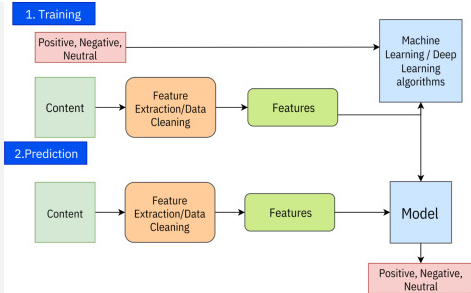
Sentiment analysis predicts the emotional polarity of text, typically positive/negative/neutral, and sometimes finer labels such as anger, joy, or frustration. In customer support, sentiment can prioritise escalations. In marketing, it can summarise brand perception.
Step 1: Pick the right label set for the business goal
Binary sentiment is simpler but may miss nuance. For service contexts, a 3-class scheme (positive/neutral/negative) is often more realistic. If you have enough data, you can expand to emotion categories, but keep labels consistent and easy for annotators.
Step 2: Fine-tune the encoder as a classifier
Most sentiment models take the special classification token representation (often [CLS]) and pass it to a small classification head. Fine-tuning updates both the head and the encoder weights, allowing the model to learn domain language such as sarcasm, informal spelling, or mixed-language text (common in Indian English + Hindi blends).
Step 3: Evaluate beyond accuracy
Accuracy alone can hide poor behaviour in minority classes. Use:
- Macro F1 to balance class performance
- Confusion matrices to understand common mistakes
- Calibration checks if you rely on confidence scores for automation
This is especially important if you are building decision systems, a common capstone topic in an AI course in Delhi.
Key Engineering Choices for Real-World Reliability
Even when models look strong in notebooks, production brings new challenges:
Domain shift and continuous improvement
Customer language changes: new product names, trending complaints, or campaign-specific terms. Maintain a feedback loop:
- Sample misclassifications weekly
- Add new labelled examples
- Re-train or fine-tune periodically
Handling long text and multi-sentence context
Standard BERT has a token limit (often 512 subword tokens). For long tickets or reviews:
- Use chunking with aggregation (average sentiment, max negativity, etc.)
- Apply sliding windows for NER to avoid cutting entities
- Consider long-context encoders if needed
Performance optimisation
To reduce latency and cost:
- Use DistilBERT-like models for faster inference
- Apply quantisation or ONNX optimisation
- Batch requests and cache repeated inputs
- Monitor latency, throughput, and drift
Conclusion
BERT-based encoders make NER and sentiment analysis far more accurate and adaptable than traditional NLP methods, but strong results depend on clear labelling, domain-relevant training data, careful evaluation, and production-minded engineering. If your goal is to build practical NLP systems—whether for support triage, reputation monitoring, or knowledge extraction—these two implementations offer a reliable foundation. For many practitioners taking an AI course in Delhi, mastering these pipelines is an excellent step towards building modern, deployable NLP solutions.